

Executive Summary
Markets are shifting faster than most leadership teams can respond. Companies that pull ahead are not always the ones with the newest technology. They are often the ones that recognize new knowledge, absorb it, and apply it before competitors catch on. That capability has a name: absorptive capacity. At CFO Tech, we work with growth-stage and mid-market companies across Orange County and beyond, building this exact muscle. This post explains what absorptive capacity means for a modern business, why it may matter more than raw technology spend, and how a unified leadership model can help your organization outlearn disruption.
5 Key Takeaways
- Most leaders feel unprepared for disruption. McKinsey’s State of Organizations 2026 research found that 72% of leaders say their organization is not fully prepared for the changes ahead [1].
- Technology spend alone will not close the gap. BCG found that roughly 60% of companies remain AI “laggards” and capture minimal revenue or cost benefit from their AI investment [2].
- AI investment is accelerating regardless. Corporate AI spending may nearly double in 2026, moving from about 0.8% to close to 1.7% of revenue [3].
- Absorptive capacity is a well-established concept. Management researchers define it as a firm’s capacity to recognize, assimilate, and apply valuable external knowledge [4].
- Executive alignment can accelerate learning speed. Industry research suggests that in the agentic AI era, an organization’s ability to absorb and act on knowledge is becoming an essential leadership skill [8].
Why Absorptive Capacity Is the New Competitive Edge
Every organization takes in information constantly. Market signals, customer behavior, and new technology all arrive at once. Absorptive capacity determines whether that information becomes a decision or simply noise.
Researchers Cohen and Levinthal introduced the term, describing it as a firm’s ability to value, assimilate, and apply new knowledge toward a commercial outcome [5]. Academy of Management Review scholars later extended the concept as a dynamic capability that shapes competitive advantage [4].
That framing matters for finance leaders today. McKinsey’s State of Organizations 2026 report, based on responses from more than 10,000 leaders across 15 countries, found organizations are facing three interconnected disruptions at once: technology, geopolitics, and workforce shifts [1]. Low absorptive capacity businesses may feel each disruption as a separate crisis. High absorptive capacity businesses can potentially treat disruption as routine input.
The Three Layers of Organizational Absorptive Capacity
Absorptive capacity generally builds across three connected layers.
Recognition
The organization must first notice new, relevant knowledge exists. This can include a shift in customer demand, a regulatory change, or a new AI capability.
Assimilation
The organization then interprets that knowledge accurately. Leadership must understand what the signal means for the business, not just that it exists.
Application
Finally, the organization acts. Insight without execution rarely creates value. This is often where absorptive capacity breaks down inside legacy structures.
Where Most Organizations Lose Absorptive Capacity
In many companies, these three layers do not connect smoothly. Data may sit in one system while decision-making authority sits elsewhere entirely.
Legacy ERP platforms can compound the problem. When financial and operational data live in disconnected systems, recognizing disruption early becomes harder. CFO Tech’s composable ERP approach is designed to reduce this friction by connecting AI-first modules into existing platforms.
Siloed leadership creates a similar drag. When finance, technology, and operations report separately, assimilation slows because no single team owns the full picture. CFO Tech’s earlier research on function-centric workflows found that most enterprise slowdowns are structural, not technological.
BCG’s research on AI value capture suggests only about 10% of AI value comes from algorithms themselves. Roughly 70% may come from operating model changes, including how decisions get made [2]. Technology is rarely the bottleneck. The structure around it usually is.
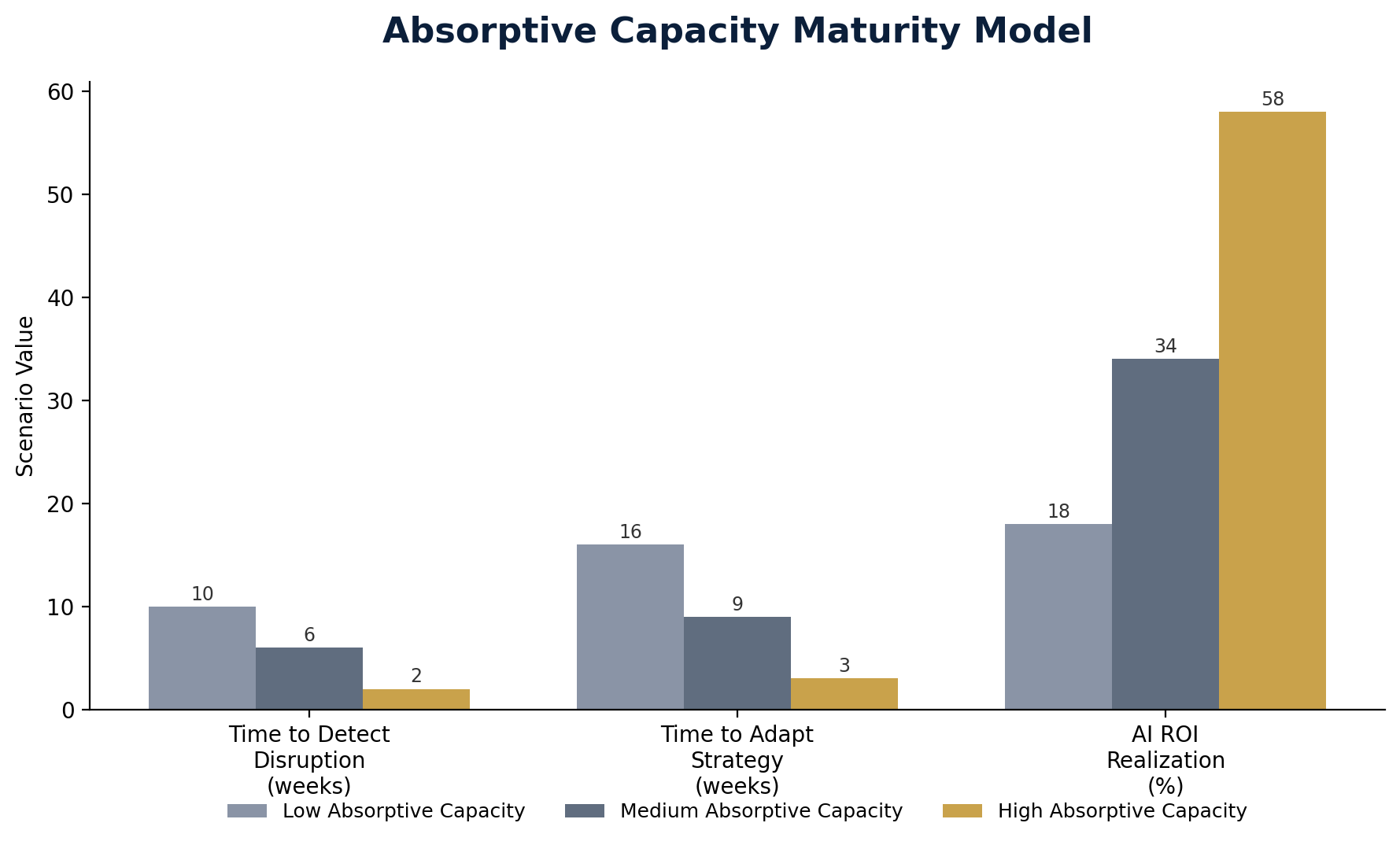
Disclaimer: The chart above illustrates potential scenario-based outcomes across low, medium, and high absorptive capacity organizations. These figures are approximate and directional, drawn from patterns referenced in publicly available industry research including McKinsey and BCG. Actual results will vary by company size, industry, data infrastructure, and leadership structure. This chart does not represent a performance guarantee for any specific organization.
How Unified Executive Leadership Builds Absorptive Capacity
Absorptive capacity is not just a data problem. It is fundamentally a leadership design problem.
When financial and technical decisions happen in sequence rather than together, assimilation slows down. A CTO may spot a shift months before the CFO understands the financial implication, or the reverse.
CFO Tech’s Unified Executive service model addresses this directly. It blends CFO, CTO, and Chief AI Officer capabilities into one engagement, so recognition, assimilation, and application happen inside the same conversation rather than across separate departments.
Deloitte’s Q1 2026 CFO Signals research found finance leaders are increasingly prioritizing cost management amid ongoing uncertainty [10]. A unified structure can help ensure cost discipline and technology strategy are evaluated together.
Wolters Kluwer’s 2026 CFO research frames this directly: an organization’s capacity to absorb external knowledge and apply it for impact is becoming an essential competitive skill in the agentic AI era [8]. That capacity is typically built at the executive level and is difficult to delegate down.
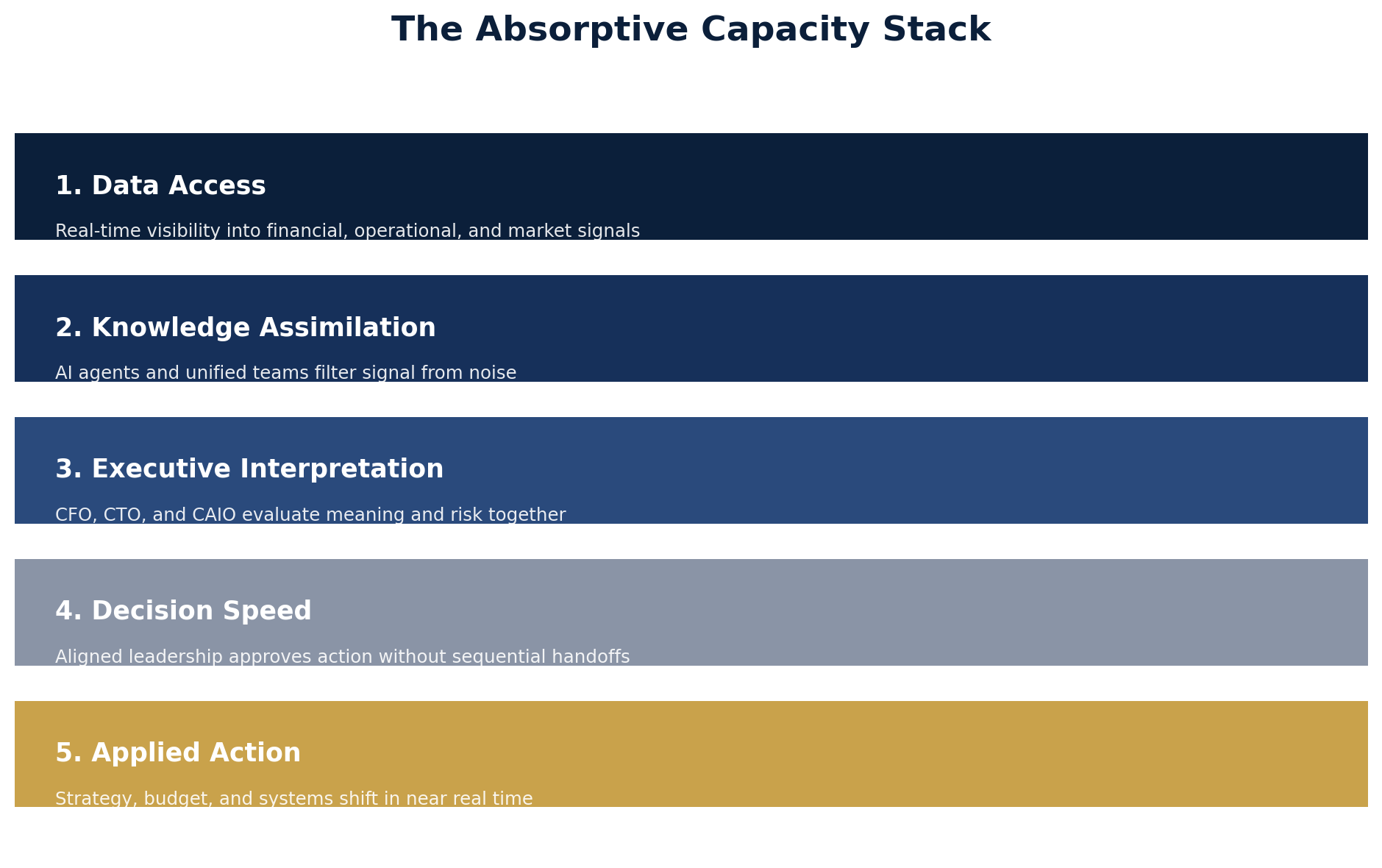
Disclaimer: The model above represents a simplified, illustrative view of how absorptive capacity may function inside an organization. It is intended for strategic planning and educational purposes only, and reflects general patterns observed in industry and academic research rather than a specific measured outcome for any company.
Building Absorptive Capacity in Your Organization
Most companies do not need to rebuild their entire structure. They need a deliberate way to connect knowledge intake with decision-making.
A practical starting point may include the following steps.
- Audit where knowledge currently gets stuck. Map how long it takes for a market or operational signal to reach a decision-maker.
- Connect financial and technical reporting. Shared dashboards can help finance and technology leaders see the same data at the same time.
- Reduce sequential approval layers. When possible, involve financial and technical stakeholders in the same conversation rather than passing decisions down a chain.
- Treat AI as an assimilation tool, not just an automation tool. AI agents can potentially help filter and interpret signals faster than manual review alone.
PwC’s 2026 CFO research found finance teams deploying AI agents with proper governance may see up to a 40% improvement in forecasting accuracy and speed [9]. That gain depends less on the AI model and more on whether the organization is structured to absorb what it produces.
Frequently Asked Questions
What is absorptive capacity in a business context? It is an organization’s ability to recognize valuable new information, understand it correctly, and apply it to real decisions [4][5].
How is absorptive capacity different from digital transformation? Digital transformation means adopting new tools. Absorptive capacity means how well an organization uses the knowledge those tools generate. A company can own advanced technology and still have low absorptive capacity.
Can a mid-market company realistically build absorptive capacity? Yes. It ties more closely to leadership structure and decision speed than to company size. Mid-market companies may build it faster since they carry fewer legacy approval layers.
How does CFO Tech help companies build absorptive capacity? CFO Tech’s Unified Executive service combines CFO, CTO, and CAIO functions into one team, connecting data, decision-making, and execution to shorten the gap between recognizing change and acting on it.
What is the first step toward improving absorptive capacity? Map how information currently moves from the market into an executive decision. Where that process slows down often reveals the biggest opportunity.
Ready to Build an Organization That Outlearns Disruption?
Absorptive capacity is not a future concept. It is already separating the companies adapting quickly from those still catching up.
CFO Tech works with growth-stage and mid-market companies to build the leadership structure, data infrastructure, and AI strategy needed to absorb change faster than it arrives.
Schedule a consultation today and let’s explore what stronger absorptive capacity could mean for your organization.
Key References
- Source [1] McKinsey & Company, “The State of Organizations 2026” (2026) — https://www.mckinsey.com/featured-insights/mckinsey-global-surveys
- Source [2] Boston Consulting Group, “The Widening AI Value Gap: Build for the Future 2025” (September 2025) — https://www.bcg.com/press/30september2025-ai-leaders-outpace-laggards-revenue-growth-cost-savings
- Source [3] Boston Consulting Group, “AI Radar 2026: As AI Investments Surge, CEOs Take the Lead” (June 2026) — https://www.bcg.com/publications/2026/as-ai-investments-surge-ceos-take-the-lead
- Source [4] Zahra, S. A. and George, G., “Absorptive Capacity: A Review, Reconceptualization, and Extension,” Academy of Management Review, 27(2) — https://journals.aom.org/doi/10.5465/amj.2005.19573106
- Source [5] Springer Nature, “Absorptive Capacity and Organizational Learning” — https://link.springer.com/rwe/10.1007/978-1-4419-1428-6_1620
- Source [6] Sancho-Zamora, R. et al., “The Impact of Absorptive Capacity on Innovation: The Mediating Role of Organizational Learning,” International Journal of Environmental Research and Public Health (2022) — https://www.ncbi.nlm.nih.gov/pmc/articles/PMC8776093/
- Source [7] Organization Science, “Absorbing the Concept of Absorptive Capacity: How to Realize Its Potential in the Organization Field” — https://pubsonline.informs.org/doi/10.1287/orsc.1090.0503
- Source [8] Wolters Kluwer, “The Evolving CFO: Five Strategic Trends Reshaping Finance Leadership in 2026” (January 2026) — https://www.wolterskluwer.com/en/news/evolving-cfo-5-strategic-trends-reshaping-finance-leadership
- Source [9] PwC, “What’s Important to the CFO in 2026” (2026) — https://www.pwc.com/us/en/executive-leadership-hub/cfo.html
- Source [10] Deloitte, “Facing Uncertainty: North American Finance Leaders Zero In on Cost Management — Q1 2026 CFO Signals Survey” (April 2026) — https://www.deloitte.com/us/en/insights/topics/business-strategy-growth/1q-2026-cfo-signals-survey.html
Disclaimer: This blog post is intended for general informational and educational purposes only. It does not constitute financial, legal, or technology implementation advice. Statistics, projections, and performance estimates referenced in this post are drawn from publicly available third-party research and industry reports, or from illustrative scenario models created for explanatory purposes. Results described or implied are potential scenarios and may vary significantly based on individual company circumstances, technology infrastructure, team composition, and implementation approach. CFO Tech makes no guarantees regarding specific outcomes. Readers should consult qualified financial and technology professionals before making any strategic or investment decisions. All third-party trademarks, research, and brand names are the property of their respective owners and are referenced for informational purposes only.